




Innovations in emergency care
Over the past two years, increasing numbers of patients have turned to Skagit Regional Health’s hospitals for emergency care, placing added demand on Emergency Departments (EDs) at both Skagit Valley Hospital and Cascade Valley Hospital.
As more people seek urgent care, health systems must rethink long-standing processes to ensure patients are seen quickly and safely. Guided by a commitment to continuous improvement, Skagit Regional Health redesigned key aspects of emergency care delivery to better serve patients while managing rising volumes.
Despite this dramatic increase in visits, both EDs have achieved notable improvements:
- Fewer patients are leaving without being seen by a doctor.
- Patients are now seen, on average, by a doctor within less than 20 minutes of arrival, compared to about an hour.
This success reflects the intentional design of our new triage model and a shared dedication to delivering timely, reliable emergency services.
“When everyone understands that early care—not early room placement—is the priority, frustration decreases and trust increases.” – Bianca Gordon, Chief Nursing Officer, Skagit Regional Health
A new approach to triage: Faster care, earlier treatment
Previous model
The standard emergency visit sequence has traditionally been as outlined below.
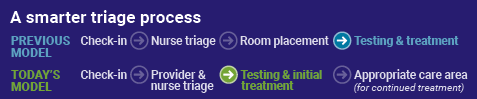
Today's model
But in today’s high-volume environment, waiting for a room before beginning care can slow down the entire process. Skagit Regional Health’s improved triage model has transformed that experience:
This new process allows the clinical team to begin labs, imaging and initial treatments while patients wait, rather than after they are placed in a room.
“This shift ensures that care begins earlier and more efficiently,” said Karen Watkins, Regional Director of Emergency Services for Skagit Regional Health. “This is because waiting for a bed often takes longer than processing tests.”
“Healthcare has changed,” said Brenda Hubin-Price, Manager of Emergency Medicine at Cascade Valley Hospital. “This new triage model is being used throughout the country.”
With limited bed space and rising demand, this model ensures that no time is wasted and care begins as soon as possible.
The new model also includes dual triage, where a provider and nurse work side by side from 9 a.m. to 9 p.m., the busiest hours of the day. Dual triage significantly reduces the amount of time it takes for a patient to be seen by a doctor. Patients know that their care is underway—even if they return to the waiting room afterward.
Why am I back in the waiting room?
It can be confusing or frustrating to return to the waiting area after you’ve already been evaluated. Although a patient is not moved to a room right away, care is already underway.
Diagnostic tests have been ordered, medications have been started and the care team is actively working on next steps. Beginning care early—even before a room is available—helps shorten overall treatment time and allows our Emergency Departments to care for patients as safely and efficiently as possible.
According to Gordon, “Educating both staff and the community is essential. When everyone understands that early care—not early room placement—is the priority, frustration decreases and trust increases.”
Triage and treatment
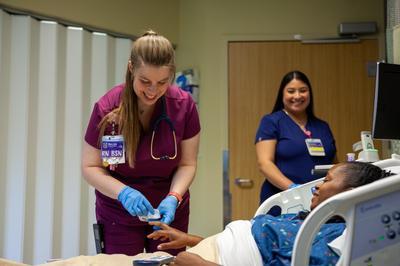
When a patient arrives at either of our EDs, a specially trained triage nurse assesses their symptoms, vital signs and medical history to determine how quickly they need to be seen. The triage provider then decides what tests or treatments are needed. Every care plan is based on a full evaluation—not just test results—to ensure the safest, most appropriate treatment.
As Hubin-Price emphasizes, “Your untriaged patients could be your sickest patients.” This philosophy has guided the team’s efforts to ensure that every patient is assessed quickly and safely.
More responsive emergency care for our community
Through innovative improvements, strong teamwork and a thoughtful focus on patient-centered care, Skagit Valley Hospital and Cascade Valley Hospital are delivering faster, more reliable emergency services than ever before. By starting care earlier and refining each step of the process, Emergency Department teams are helping ensure patients receive appropriate care when they need it, while continuing to adapt to the demands facing emergency services today.
.png?sfvrsn=a41c6a3e_1)